Stefano Stramigioli is rebuilding robot control on the language of energy, geometry, and physical structure
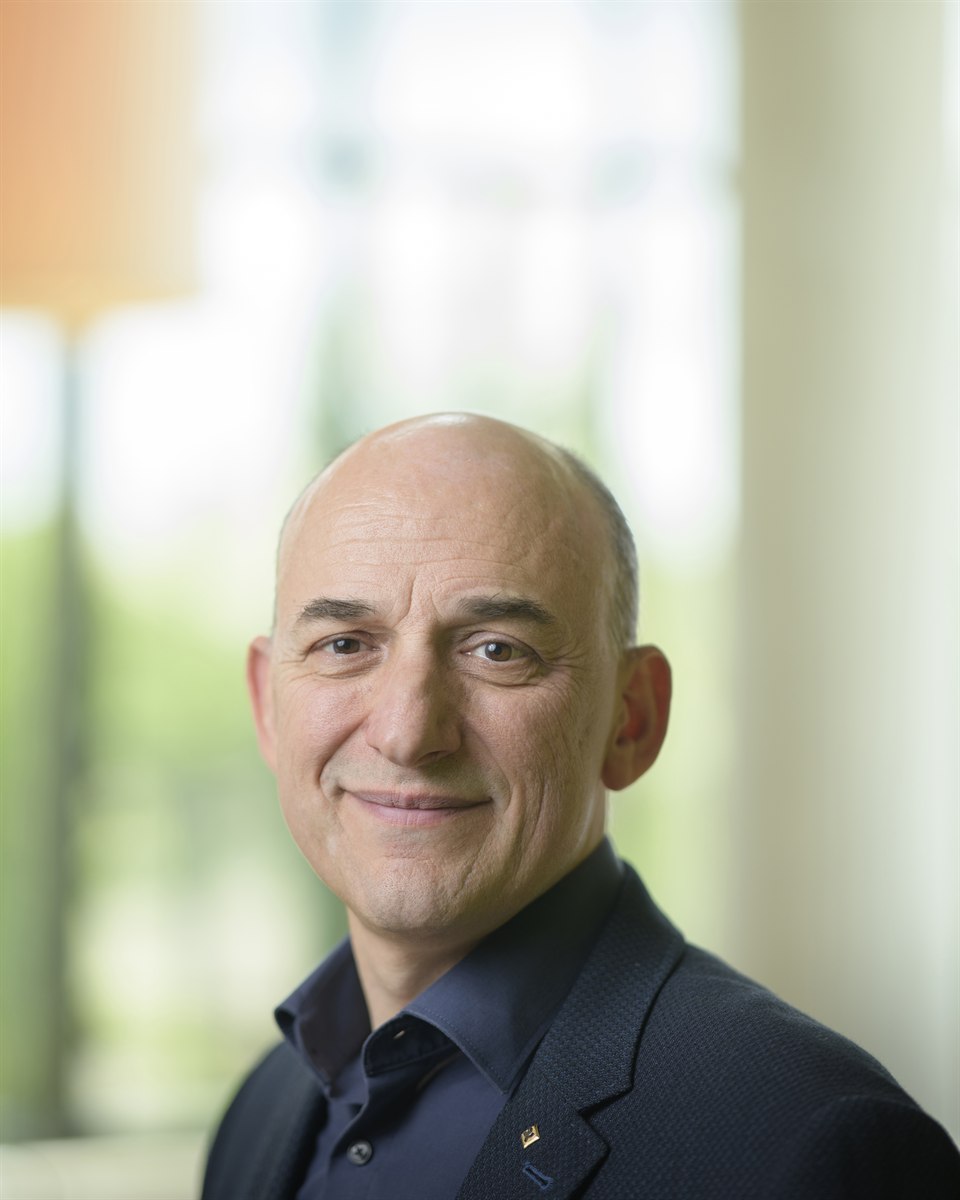
By grounding control in port-based thinking, port-Hamiltonian systems theory, and geometric methods, he bridges classical physical insight with the demands of modern aerial, surgical, and autonomous robots.
What is your role and what does it involve?
I would first of all describe myself as a scientist who is driven by the passion for learning to understand nature and use such knowledge to build stuff like robots. Second, I have the pleasure and privilege to lead the Robotics and Mechatronics Lab of the University of Twente which I created in the years with the help of many other talented colleagues and students.
What do you find most interesting or enjoyable about your work?
Learning, understanding, and creating is what I live for. This is by chance my work and I am paid for it, but doing what I do is what I need to enjoy life. That gives me purpose, happiness and I will keep on doing it until my last breath, not until I retire.
Tell us about your research (include an explicitly stated long-term goal)
I see myself first of all as a System Theorist. I believe that after math, system theory is the most important subject for an engineer and a scientist. Math is the greatest creation of human kind, and everything is a system. A robot is a system and the universe is a system; there is no difference. As Poincaré states it “the art of Mathematics is to give the same name to different things”, and that means to abstract and get rid of what does not matter. As Engineers and Scientists, that is precisely what we need to do. I see solving a problem not as the end goal of what I do, but as a journey which brings me to understand systems, how they work, and change their behavior as done with control.
What led you to pursue a research career in this field?
I have always built stuff since I was very small. I built the first circuits when I was 6, playing with batteries and lights and for my graduation at the technical school before university, I built a 5 degrees of freedom robot controlled by a Z80 microprocessor, programmed in assembler for which I could learn motions. I presented it at my technical school graduation and poured water to members of the committee which were pretty astonished. I really enjoyed doing the machining, the electronics and the programming. After I decided to do engineering and then at university I discovered the beauty and power of mathematics and formal methods to understand systems of any kind. Thanks to a phenomenal professor of Linear Algebra, Prof. Massimo Ferri, who I am still in contact with, I have then discovered that what I wanted to do is stay in academia.
What working achievement and/or initiative are you most proud of?
I am proud of the insights I believe I managed to give on physical interaction of robots, modeling of non-linear elastic material interacting with Fourier-Navier Stokes PDEs, a solution to time delays, passive sampling, concepts of variable impedance actuators I have worked on and many other things, but I believe the core common denominator is the methodology to model and control using duality and ports for finite and infinite dimensional systems in a covariant way. That is I believe in the most fundamental core of nature, and I am applying such concepts now in theoretical physics.
What’s next on the research horizon for you?
I have been working for the last 2.5 years on very fundamental questions of theoretical physics. This came up from some insights I gained during my ERC PortWings. I have discovered some mathematical structures which I had the feeling could do much more and they definitely do. I believe I have a way to completely disentangle the background of quantum fields and therefore give a way to connect quantum fields to general relativity. This is quite a claim, but I believe I practically made it and will hopefully publish some results soon. I had some preliminary results which I put online, and I had sent them to a physics journal for which I had the first editorial rejection of my life. This was an eye opener for me because it let me understand how, some “scientists” are closed minded, keep on working in their field without ever doing proper philosophy about what they do, and I think that is the reason why physics, after 100+ years, have not been able to connect QFT to GR. I personally do not even care if my work on this stuff will be recognised, because I know it is valuable and will put it online anyhow, and I believe that sometime in the future people will recognise the contribution.
Can you share some interesting work that you read about recently?
As I am working on theoretical physics at the moment, I am not sure your readers would be interested, but I am digging into, for me, most fascinating questions in nature, and I think I have an understanding now of many things which are normally considered “mystical”, and I love that!
How do you balance research with the other demands of your position?
I have the fortune to have a group now full of independent Pis. I have been very active in the past in many ways on IEEE, euRobotics and many other things. I then realised, thanks to my ERC that, even if I could contribute doing such tasks, what I really love is research and teaching, and decided from now on to do that as much as I can being very selective on all other stuff. As said before, research is my hobby, and therefore, if I am also on vacation with my family, if we are together, I enjoy the time with them, but if they are “baking in the sun”, I study or do my calculation: that is vacation for me 🙂
Stefano Stramigioli’s Links
Personal website Robotics and Mechatronics Lab (RaM) Google Scholar LinkedIn