Christian Ott is advancing the fundamental principles of robot control to enable safe and natural physical interaction.
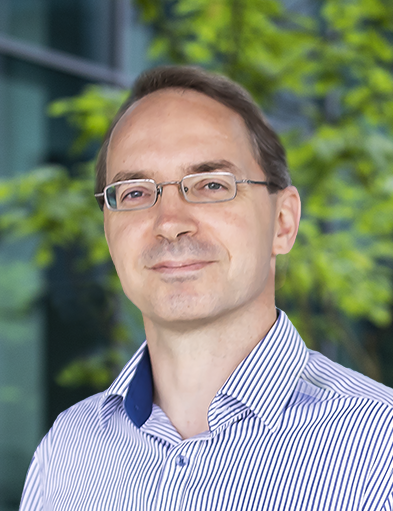
By exploiting the structure hidden in complex system dynamics, he develops interpretable and trustworthy control methods for manipulation and locomotion.
What is your role and what does it involve?
I hold a professorship at TU Wien in Vienna, Austria, while maintaining a part-time affiliation with my former institution, the German Aerospace Center (DLR) in Munich. Rather than treating these as separate roles, I see them as an opportunity to bridge TU Wien and DLR through our recently established Joint Lab, fostering an open, continuous exchange of ideas, people, and expertise. At TU Wien, I teach primarily at the Master’s level, covering both the foundations of robotics and advanced robot control for manipulation and locomotion. I greatly value this combination: it allows me to guide students from the core principles of the field toward topics at the forefront of current robotics research. Staying connected to the wider robotics and control communities is equally important to me. Within the IEEE Robotics and Automation Society, I currently serve as Editor-in-Chief for ICRA and I serve as a Council Member of IFAC.
What do you find most interesting or enjoyable about your work?
Robotics has always been a great inspiration for control, and many fundamental control methods have their roots in robotics problems. What I particularly enjoy about the field is the balance between theory and experiments. I am drawn to approaches that have a solid theoretical foundation and are derived from first principles whenever possible. At the same time, I find it very rewarding to see these ideas work on real systems. Robotics offers an ideal environment for this: theories can be developed rigorously, tested in practice, and improved based on what we learn from experiments.
Tell us about your research (include an explicitly stated long-term goal)
At the beginning of my academic career, I fully dedicated myself to compliant impedance-control approaches for lightweight robots, using integrated joint-torque sensors to achieve highly sensitive and backdrivable behavior. I remain convinced that physical compliance and impedance control are essential for robust physical interaction. Somewhat in contrast to the goal to achieve soft behaviors via control, I also gained interest in tasks involving non-smooth contact transitions and impacts. One of my current goals is to enable robots—including sensitive collaborative robots—to carry out demanding tasks such as hammering or punching without sustaining serious damage.
Although I initially investigated these challenges in the context of manipulation with single robotic arms, after completing my PhD I turned my attention to more complex systems, particularly humanoid robots. I found that many control paradigms originally developed for manipulation could also be transferred effectively to locomotion. This insight contributed to the development of the torque-controlled humanoid robot TORO, for which we established a passivity-based, compliant whole-body control framework that serves as the foundation for higher-level locomotion capabilities.
An overarching principle of my research is that robust control begins with a thorough understanding of a system’s dynamics. I use this understanding—and, in particular, the system’s structural properties—to design control methods that often provide formal guarantees, such as passivity. The same principle underlies our locomotion framework, in which the divergent component of motion emerges naturally from the robot’s center-of-mass dynamics. More recently, we have been working to combine the physical insight and formal guarantees of these model-based approaches with the adaptability and expressive power of learning-based methods.
What led you to pursue a research career in this field?
At the university I was pretty impressed by the field of control engineering, which was introduced to us as a broad, coherent theory of linear system dynamics in which one could go back and forth between different representations (namely frequency space and state space). My inspiration for robotics came later at the end of my university time. At the university I had learned that forces are not vectors (but co-vectors), but this sounded more like a philosophical statement to me. By chance I joined a lab excursion to the DLR and during the demos a researcher (who later became my PhD supervisor) started to discuss the geometric control approaches for their new robot. Suddenly, the dots connected. From then on, everything developed quite naturally.
What working achievement and/or initiative are you most proud of?
During my PhD I was working on interaction control of robots with joint elasticity. At that time joint torque sensing and control was a hot topic. Maybe my most important contribution to this field was to recognize that force feedback in an elastic robot could be interpreted physically as a virtual scaling of the motor inertia. Nowadays, this property seems to be very natural and not so surprising anymore. But at that time this physical interpretation allowed to explain some terms in the stability analysis, which before appeared just as clever mathematical choices. This finding subsequently opened up many generalizations and new control approaches in my later work, and I was very happy to see that it recently also was useful for researchers working on impact models for torque controlled robots.
What’s next on the research horizon for you?
I see a strong trend in the robot control community towards learning based approaches. I see my role in grounding such algorithms with fundamental knowledge from systems theory and automatic control. Combining the generalizability and robustness of learning-based methods with formal guarantees and interpretability of analytical approaches seems to be an important challenge to me.
Can you share some interesting work that you read about recently?
Recently, I read several papers on physics-informed neural networks whose architectures incorporate Hamiltonian dynamics. This allowed the authors to provide formal guarantees for properties such as passivity. I found these works very inspiring because they seek to combine two complementary strengths: the generalizability of learning-based methods and the interpretability gained by imposing structural properties.
How do you balance research with the other demands of your position?
I am truly grateful for the support of my team members when I am overloaded with editorial or administrative tasks, including proposal writing. In return, I do my best to stay closely involved in the specific research challenges they face and to make enough time for regular meetings with all my colleagues.